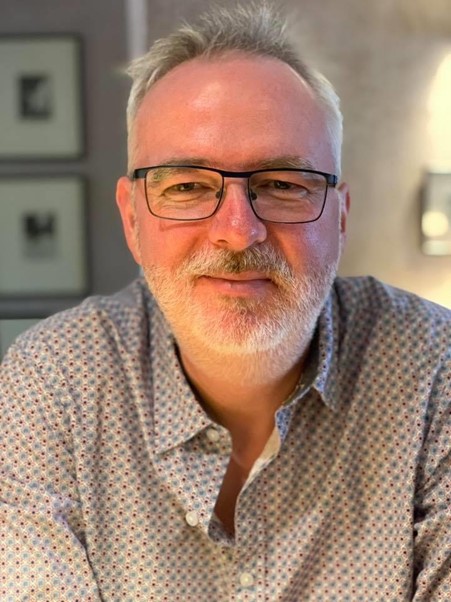

Duncan Edmonstone
It’s July 2019 – I’ve just finished presenting at a sales event for my company in central Birmingham and have driven back to my home in Cheshire. No rest for the wicked, though; I still have work to do, so I say hi to my wife before stepping into my office to catch up on emails. About 15 minutes after sitting down, I start to feel unwell. My tongue starts to feel thick, and I’m struggling to talk. I tell my wife, and then everything goes crazy! I lose control of the left side of my body and start convulsing. I don’t know it at the time, but I’m having a brain seizure. Just 15 minutes later, I am sitting on the sofa feeling dazed and a bit scared, talking to paramedics – my wife thought I was having a stroke and had called an ambulance.
What followed was a 5-week whirlwind of hospital stays, appointments with consultants, scans and biopsies, culminating in brain surgery to remove a tumor and a diagnosis of Stage 4 metastatic non-small cell lung cancer. I’d gone from being a reasonably healthy 49 year old to recovering from major surgery and being told I had an incurable disease all in the space of a few weeks. Of course, I did what you should never do and I searched the internet for information on typical life expectancy for a patient like me. At the time, the median life expectancy for a Stage 4 lung cancer patient in the UK was less than a year – a sobering statistic.
What changed for me at this point was the additional biomarker testing done on my biopsy, which found my cancer was driven by a single specific mutation, known as an ALK fusion. Suddenly, instead of staring down the barrel of radiotherapy, chemotherapy, and possibly further surgery, I was just going to take tablets – a targeted therapy drug that could pinpoint the specific cancer cells and starve them of the energy they need to divide and multiply. The prognosis went from less than a year to years, and I connected with other ALK patients through a support group, where I heard about patients living for many years on the treatments I would be taking. I started on the treatment, and the results were really good. I was even able to return to work just 3 months after that first seizure.
It's now been over 6 years. I continued to work for 4 years before taking the opportunity to retire early. I’ve been on the same targeted therapy drug since August 2019. After my surgery, I’ve had no further tumors in my brain, the tumors in my lungs have reduced to just scarring, and the indication of cancer in my lymph nodes has also cleared up. I have a few minor side effects from the drugs, but nothing that stops me from leading a relatively normal life. My interaction with the healthcare system now consists of a monthly blood test and a telephone consultation with my lung cancer Clinical Nurse Specialist at The Christie Hospital in Manchester. Every 3 months, I also have a computed tomography (CT) scan and a magnetic resonance imaging (MRI) scan to check for any signs of progression, after which I see my oncologist. To my great relief, despite the odd minor hiccup along the way, I have remained entirely well.
As I’ve moved out of the world of work, I’ve found time to get involved in patient advocacy. I benefited greatly from the words and work of patient advocates who came before me, so I now see it as my duty to pay it forward to the next generation of patients and carers. After a career working in information technology, I have particular interests in the use of data in healthcare systems and how technology can improve patient experiences and simplify healthcare professionals’ work. I’ve worked at both the local and national levels within healthcare organizations and with third-sector organizations.
There’s a reason why cancer is known as “the emperor of all maladies”; when you get diagnosed, it hits you like an express train, and it’s so tempting to curl into a ball and retreat from the world. I remain unconvinced that a positive attitude makes any material difference to how our body fights cancer, but I do think that it will make the time we have left a more pleasant experience for us and our friends and family. While I know it is likely cancer will return at some point, I now have real hope that I will get to enjoy a longer life than I ever expected when diagnosed, and who knows, maybe I’ll be part of the first generation that sees this disease become chronic rather than terminal?